
The AI Platform Map, part 4 of 6
Stop Picking a Model. Build So You Never Have To
Platform architecture, 2026
The question I hear most from other engineering leaders is which model we should standardize on.
It is the wrong question.
Not because the choice does not matter today. Because the answer will be different in six months, and your architecture should not care.
This is layer five of the nine-layer platform map: the interchangeable model.
The model is the fastest-depreciating part of your stack
Your database choice will outlive this decade. Your cloud provider probably will too. The model you pick this quarter will probably not be the one you run next year.
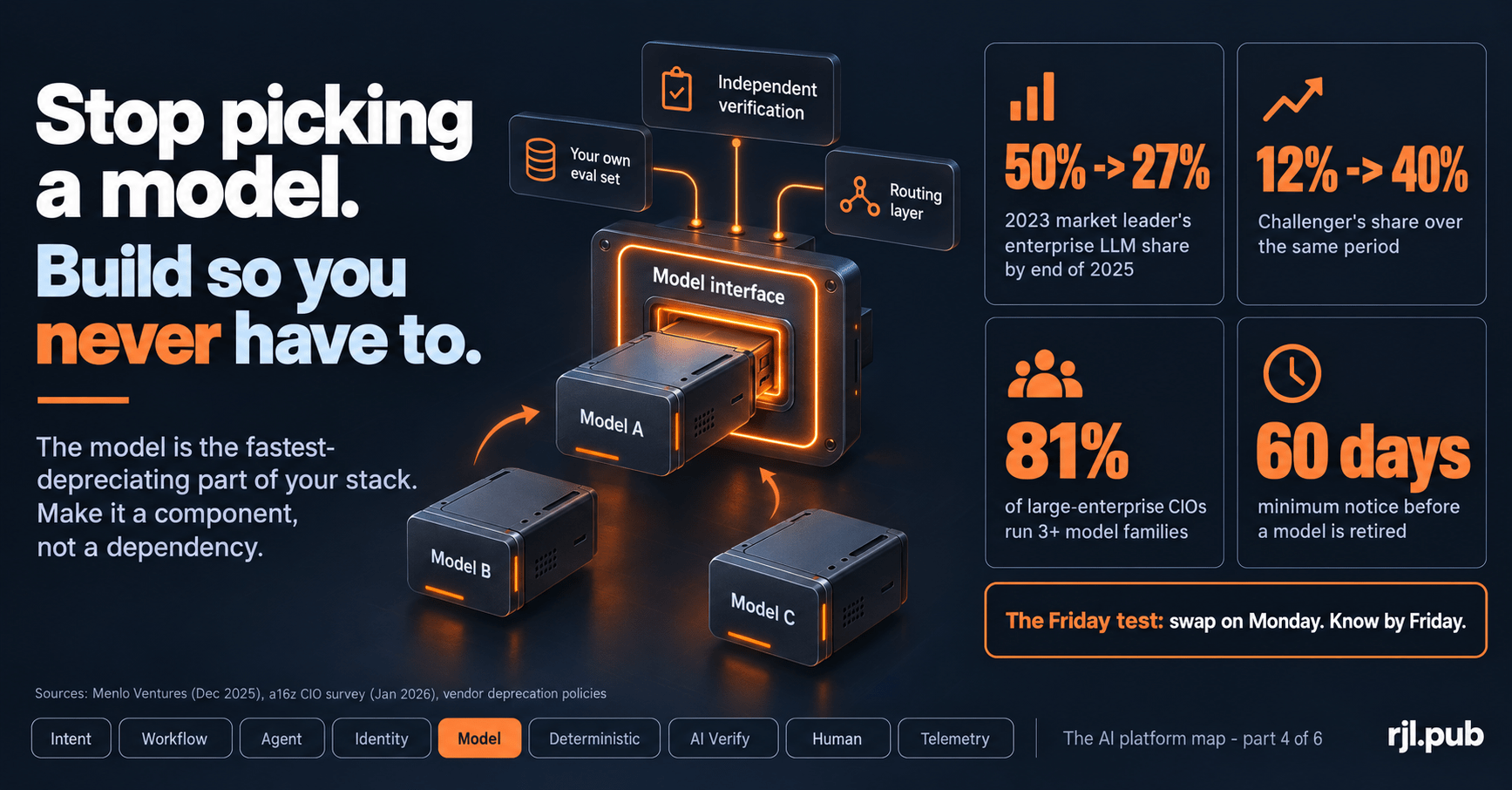
Look at who leads. By Menlo Ventures' count, OpenAI held half the enterprise LLM market in 2023 and 27% by the end of 2025. Anthropic went from 12% to 40% over the same stretch. That is not a stable market. That is a leaderboard.
Retirement runs on the vendor's calendar, not yours. Anthropic commits to at least 60 days of notice before retiring a model. OpenAI commits to at least six months for generally available models. Both are reasonable policies. Neither is a promise that your quarter will line up with theirs.
Enterprises have already voted with their deployments. In a16z's January 2026 CIO survey, 81% were using three or more model families, up from 68% less than a year earlier.
And the right model for triaging a bug is rarely the right one for reasoning about a migration, or for a task that touches data your contracts only allow certain vendors to see.
Lock-in does not come from the API
Swapping an API call takes an afternoon. That is not where teams get stuck.
They get stuck because prompts were tuned to one model's quirks and nobody wrote down which quirks. Because quality was judged by feel, so there is no baseline to compare a new model against. Because verification trusts the model's own account of what it did. Because the workflow assumes one context size, one tool-calling format, one failure pattern.
That is not a model choice. It is a model dependency.
What makes a model interchangeable
- Your own evaluation set. Built from your real work: your codebase, your tickets, your definition of correct. Public benchmarks tell you who won somebody else's test.
- Verification that does not care who wrote the code. When deterministic checks and an independent reviewer judge the output, the author becomes a replaceable detail. That is the real payoff of the next layers on the map.
- Intent and context supplied by the workflow, not baked into model-specific prompts.
- A routing layer, so a swap is a configuration change with a measured rollout, not a migration project.
The Friday test
Could you switch the model behind your agents on Monday and know by Friday, with numbers, whether quality moved?
If yes, you have a model choice. Make it as often as the market gives you a reason.
If no, the vendor is making it for you.
I have favorites. I use them every day. Favorites are fine. Dependencies are not.
What would it take for your team to swap models next week?