
The AI Platform Map, part 5 of 6
Humans Are the Exception Path
Platform architecture, 2026
Putting a human on every pull request used to be a control. At agent volume, it is a queue with a rubber stamp at the end.
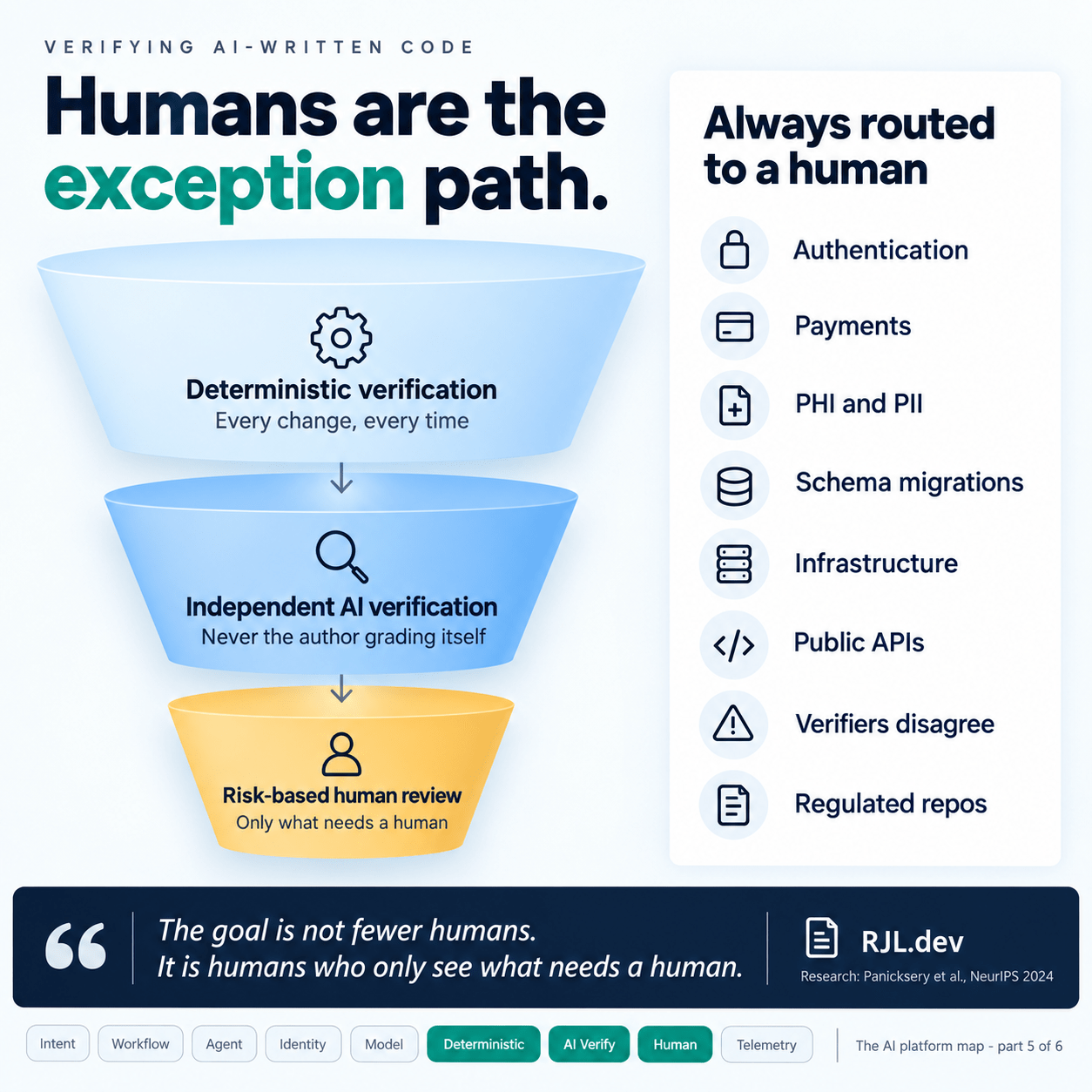
I wrote recently about the review gate going quietly unstaffed, with more changes merging and nobody's name on them. The obvious fix is to put a human back on every change. That fix does not survive the volume. People skim. Approval becomes a reflex. You get a human name on the PR and nobody actually verifying it, which is worse, because now it looks controlled.
The answer is not more human review. It is human review that lands only where it counts.
This is layers six, seven, and eight of the nine-layer platform map. They only work as a stack.
Deterministic verification. Every change, every time
Build. Types. Tests. Linters. Static analysis. Dependency and license scans. Policy as code. Migration checks. Coverage floors that actually block.
These are cheap, repeatable, and they never get tired or talked into anything. They answer one question: is this well-formed, and does it do what the tests say?
Anything a machine can check deterministically, a human should never have to.
Independent AI verification. The author does not grade its own homework
The reviewing model should not be the one that wrote the change, or at minimum should not share its context. It gets the intent and the diff. Not the author's reasoning, not its summary of what it did.
This is not just instinct. Panickssery, Bowman, and Feng showed at NeurIPS 2024 that LLM evaluators can recognize their own outputs and score them more favorably (LLM Evaluators Recognize and Favor Their Own Generations). Letting the author model review its own change is the AI version of approving your own PR.
An independent reviewer catches what deterministic checks cannot express. Does this match the intent? Did the scope creep? Is this a security smell? Is this the wrong abstraction?
Risk-based human exception
Humans see what the first two layers cannot clear, and what the risk says must be human no matter what.
Route by what the change touches, not by habit. Authentication. Payments. PHI and PII boundaries. Schema migrations. Infrastructure. Public APIs. Anything genuinely new. And anything where the verifiers disagree.
When a change reaches a person, it arrives with its evidence: the written intent, the deterministic results, the independent reviewer's findings. The human's job is judgment, not archaeology.
On regulated code
I have said there should be no auto-merge path in a regulated repository. I still mean it. In a regulated repo, the risk policy routes to a human every time.
Risk-based routing is not a loophole around that rule. It is what keeps the review that remains worth something, because the reviewer is not burned out on two hundred changes that could not have hurt anyone.
The principle
Human attention is the scarcest resource in the pipeline. Spend it where only a human adds value, and nowhere else.
The goal is not fewer humans in the loop. It is humans who only see what needs a human.
Look at last month's review load. How much of it went to changes that could not have hurt anyone?