The AI Platform Map, part 1 of 6
AI Made Generating Software Cheap. Now Make Believing It Cheap
Platform architecture, 2026
Now engineering has to make believing it cheap too. That second problem is harder, and most organizations have not started on it.
Here is the pattern. A team adopts agents. Code volume goes up. And every change still lands in the same place it always did: a human reading a diff. The generation side got an upgrade. The trust side is still running on the process from 2019.
That is not an AI strategy. It is a faster way to fill a review queue.
What a mature platform looks like
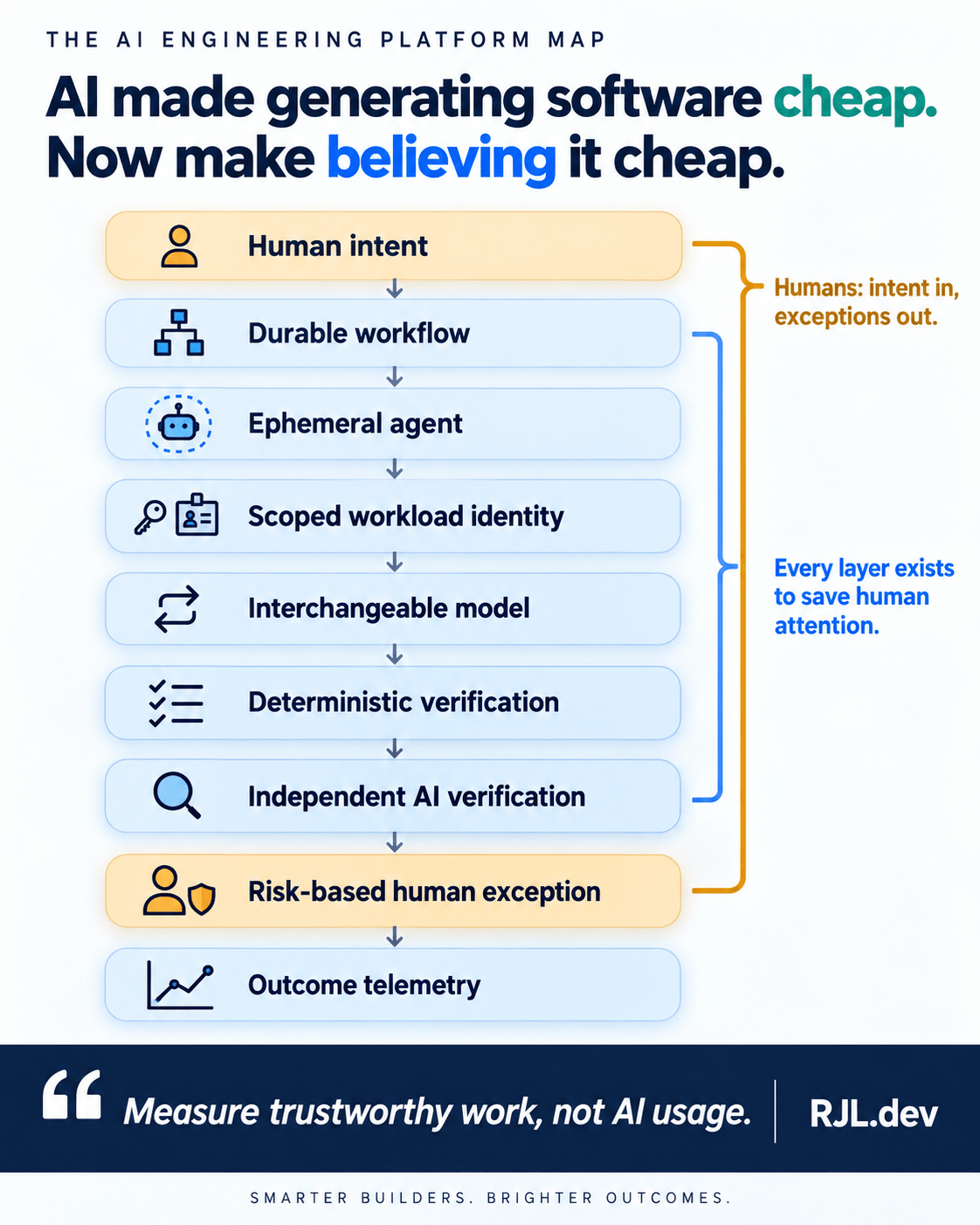
When I sketch where AI engineering platforms have to go, it comes out as nine layers:
- human intent
- durable workflow
- ephemeral agent
- scoped workload identity
- interchangeable model
- deterministic verification
- independent AI verification
- risk-based human exception
- outcome telemetry
One line on each.
- Human intent. The one input only a person can supply. What we want, what done means, what must never happen. Written down, not left in a chat window.
- Durable workflow. The job lives here, not in the agent. State, steps, retries, approvals. It survives crashes.
- Ephemeral agent. Created for one task, destroyed after. Nothing precious accumulates in it.
- Scoped workload identity. The agent gets its own short-lived credentials for that task. Not a senior engineer's token.
- Interchangeable model. A component behind an interface. Swap it next week and measure what changed.
- Deterministic verification. Builds, types, tests, scanners, policy checks. Cheap, repeatable, never tired.
- Independent AI verification. A reviewer that is not the author, checking the work against the intent.
- Risk-based human exception. People review what the first two layers cannot clear, and what the risk says must be human. Not everything by default.
- Outcome telemetry. What actually happened in production, fed back into every layer above it.
The part people miss
Look at where the humans are. The top and the bottom. Intent going in. Exceptions coming out.
Everything in between exists for one reason: to lower how much human attention it costs to trust a change.
Human attention is the scarcest resource in an engineering organization. AI did not create more of it. Every layer on that list either protects it or spends it.
In most organizations I see, the honest count is two of the nine. A model and a human. Everything else is implied, improvised, or missing.
The metric follows from the map
The biggest mistake an engineering organization can make right now is measuring how much AI it uses. Those numbers go up whether or not anything got better.
Measure how much trustworthy work gets through the system without consuming scarce human attention.
The five posts after this one take the map apart one piece at a time: intent and the durable workflow, the ephemeral agent and its identity, the interchangeable model, the three verification layers, and outcome telemetry.
Start here: count how many of the nine you have in place today. Not planned. In place.
What is your number?