Where the Bottleneck Moved
hc1, 2025-2026, and carried into SteadyIQ
Architecture review became the constraint, and we stopped trying to fix it.
I spent a good part of this year arguing that AI made judgment the whole job. The fair follow-up question was what that actually changes on a Monday morning. Here is what changed in my org.
When implementation goes from days to hours, the review queue backs up. That part is predictable. The instinct that follows is the dangerous one: speed review up, approve faster, batch more, trust the tests. That is how you generate technical debt at machine speed and call it velocity.
We went the other way. Review got slower and more expensive on purpose, because it is now the only place a human decision actually enters the system.
Quality gates got stricter, not looser
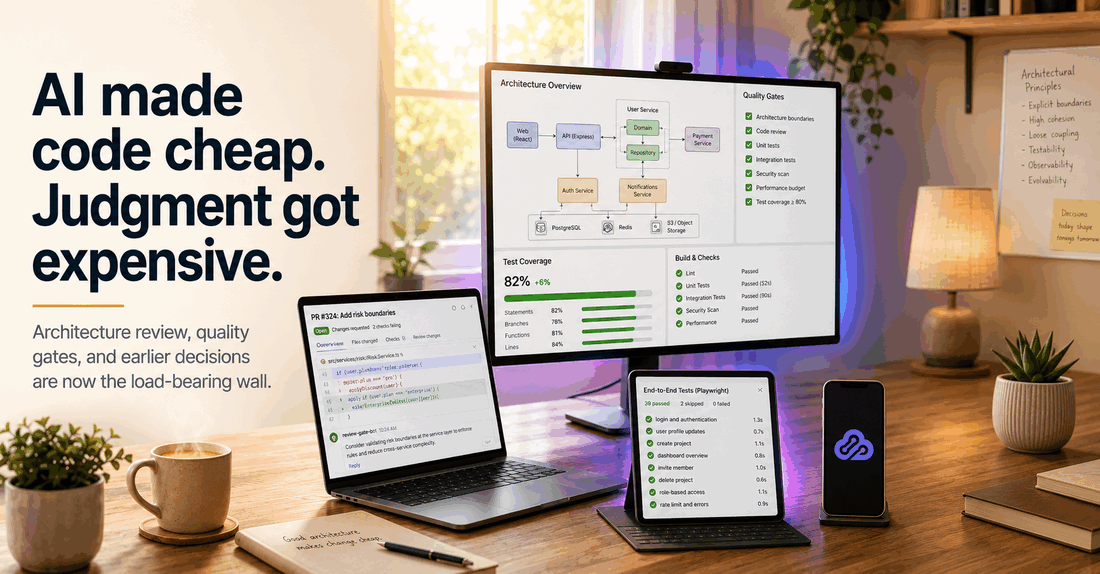
SonarQube thresholds, coverage floors, and pull request review that actually blocks. When code volume goes up 5x, gates stop being bureaucracy and start being the load-bearing wall. Every gate we relaxed to keep the queue moving, we paid for later at a worse exchange rate.
The expensive conversation moved earlier
Not "review this PR," but "should this exist, and where does it sit." Ten minutes of that conversation saves a week of generated code pointed at the wrong abstraction. The cost of a bad architectural call compounds at machine speed now, which means the cheapest place to spend human attention is before the code exists, not after.
QA stopped being downstream
I taught the quality team to generate Playwright suites with Claude directly. They went from receiving work to producing coverage in parallel. That is not a tooling change, it is an org chart change - and it is the single highest-leverage thing I did all year, because it removed the team that was structurally guaranteed to become the next bottleneck.
The uncomfortable version: if your senior engineers are still spending most of their time producing code, you are paying architect rates for something that got cheap. Their expensive skill is now review, boundaries, and saying no.
That is a harder job than writing the code was. It is also the one that does not get automated next. The mechanics of how the constraint moves, upstream into requirements and downstream into verification, are in We Did Not Remove the Bottleneck. We Moved It and on the AI Bottleneck Shift section of the home page.