We Did Not Remove the Bottleneck. We Moved It
hc1, 2025-2026
We thought AI would make us faster. It did. Just not in the way we expected.
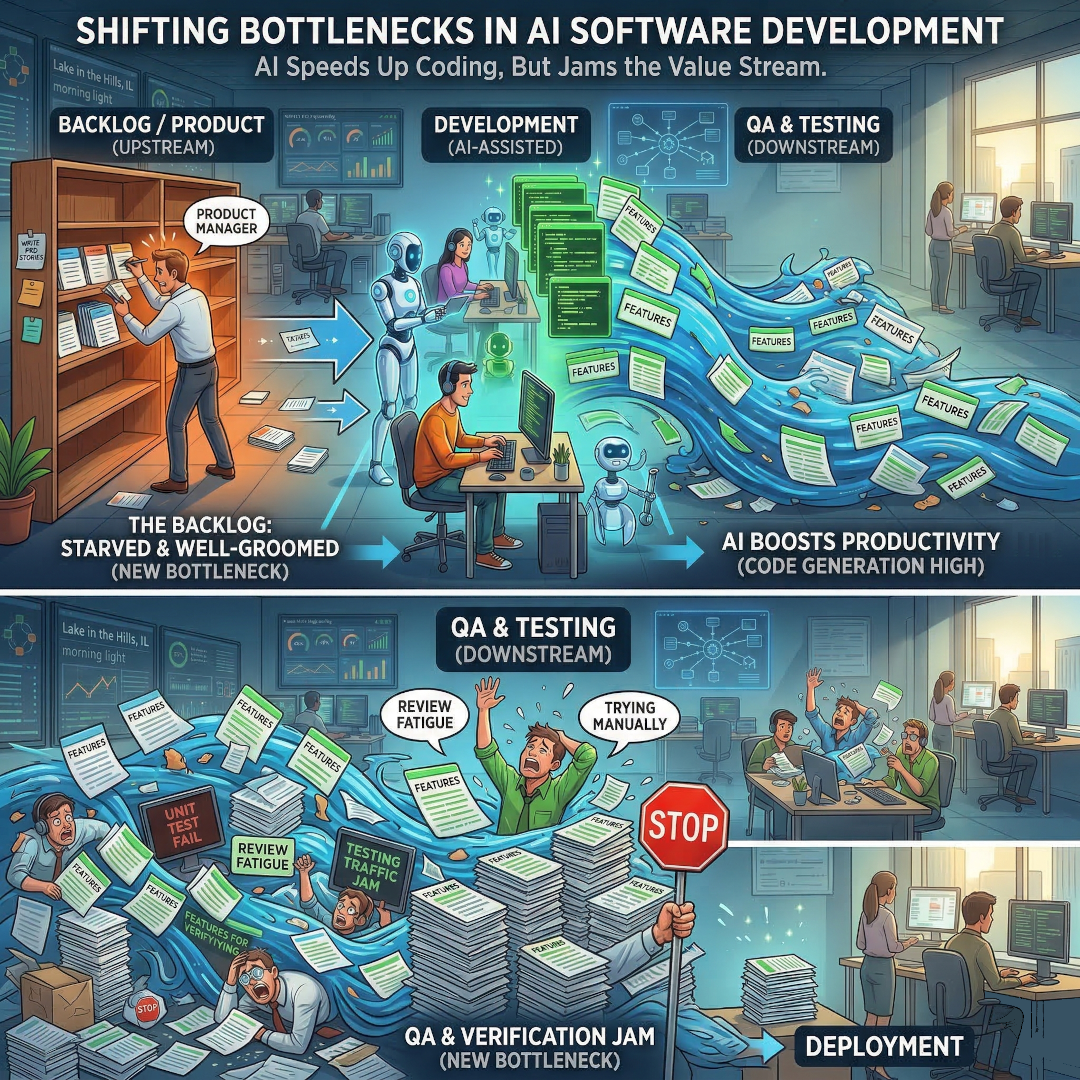
My development teams adopted AI coding tools. Output went up significantly, and code was getting written faster than ever. We thought we had cracked it. We had not. We simply moved the bottleneck.
Here is what actually happened. The coding bottleneck dissolved and immediately reappeared as four new constraints.
- Code reviews slowed everything down. AI writes code fast, but humans still have to read it, understand it, and approve it. More pull requests in the queue means senior developers are now the constraint. Reviewing AI-generated code requires more scrutiny, not less.
- QA could not keep up. More code volume at the same defect rate means more defects to catch. Human testing capacity does not scale automatically just because developers are using AI.
- The backlog got consumed faster than it could be groomed. Tickets that used to sit for two weeks before a developer touched them were getting picked up in days. Vague acceptance criteria and half-formed requirements suddenly became glaring issues.
- Downstream processes choked. Deployment pipelines, stakeholder reviews, and compliance checks did not get any faster just because the code generation did.
Goldratt wrote this down in 1984
This is not a new concept. Eliyahu M. Goldratt wrote about it in 1984. Every system has a single constraint. When you fix it, the constraint does not disappear. It moves. The Theory of Constraints was written about a factory floor, and it describes an AI-assisted software pipeline better than most of the vendor decks I have seen this year.
AI adoption without pipeline investment is like adding a sixth lane to a highway that feeds into a two-lane bridge. You did not solve traffic. You just relocated it. The difference is that the new traffic jam sits somewhere more expensive: in a senior engineer's review queue, in a QA backlog, on a release calendar nobody can move.
The question that matters
The real question for technology leaders right now is not, "How do we get more AI into our coding workflow?" It is, "Where is our constraint today, and what are we doing about it?"
If the answer is "nothing yet," then the AI rollout has bought you a faster way to fill a queue. The constraint will announce itself, usually as a review that took a week, a defect that shipped, or a ticket that got built exactly as vaguely as it was written.
What we did about it
We stopped trying to make the review queue faster and made it deliberately slower and more expensive, because it turned out to be the only place a human decision still entered the system. That story, including the quality gates, the earlier architecture conversation, and moving QA out of the downstream position entirely, is in Where the Bottleneck Moved. The upstream and downstream mechanics, with the picture, are on the AI Bottleneck Shift section of the home page.
AI does not remove the constraint. It moves it, and it moves it toward the people whose time was already the most expensive thing in the building. Find it before it finds you.