
Adoption Is a Trust Problem, Not a Tooling Rollout
Pattern across several orgs, 2024-2026
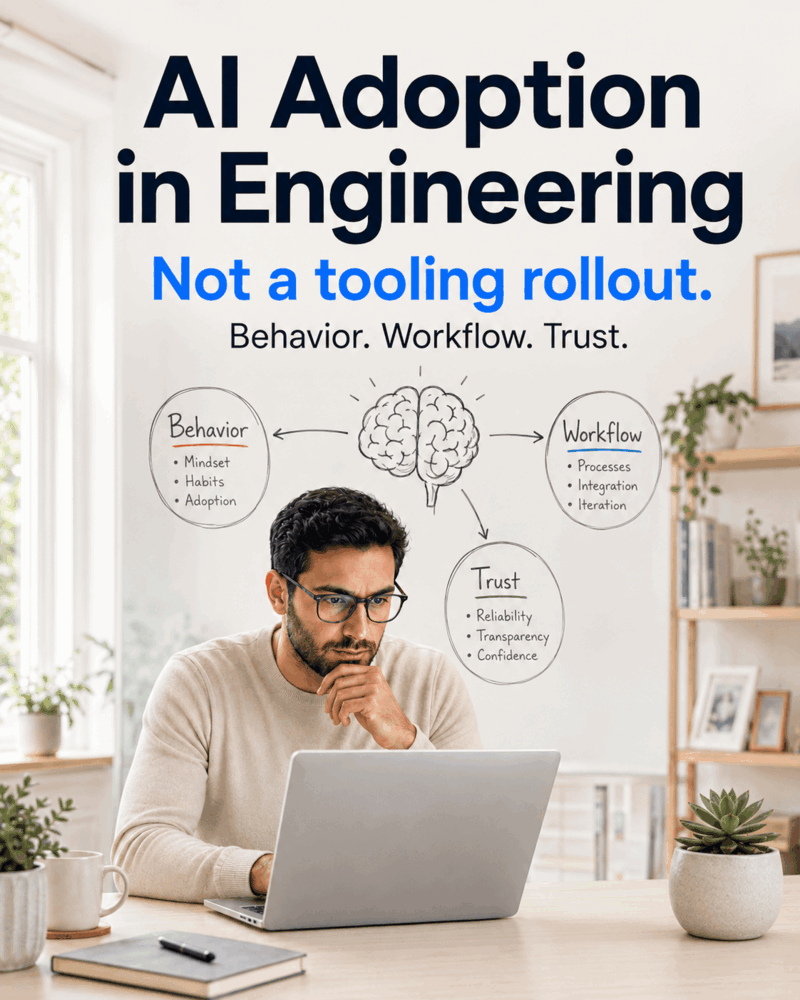
It is a behavior change, a workflow change, and a trust problem wearing a hoodie.
Increasing AI adoption is not about buying more tools. It is about removing the friction between "I should try this" and "this actually helps me ship better software."
Most engineering teams do not have an adoption problem because engineers are resistant. They have an adoption problem because leadership rolls out AI like a corporate wellness program.
Start where the pain already has budget
Do not lead with "here is our AI strategy." Lead with where we are losing time, where reviews are slow, where tests break trust, where onboarding hurts, and where developers are doing repetitive work a machine can handle badly at first and well with guardrails.
Make it part of the workflow
If engineers have to leave the IDE, context switch, paste code into five tools, and reconcile the output by hand, adoption dies. The best AI tooling feels like infrastructure, not homework. It lives inside the SDLC - requirements, architecture, coding, testing, review, security, CI/CD, documentation, incident response - not as a demo, as a pipeline stage.
Guardrails, not handcuffs
Engineers need clear rules about what data can be used, what tools are approved, what requires review, and what must be verified before merge. The goal is not to move fast and hallucinate things. The goal is to move faster with evidence.
Measure outcomes, not vibes
Adoption is not measured by license count. Cycle time, review speed, test coverage, escaped defects, onboarding time, incident triage, toil, developer flow - those are measures. If the metric is "we bought 200 seats," congratulations, procurement had a sprint.
Treat skepticism as a feature
A skeptical engineer is not blocking progress. They are protecting production. Bring them in early, let them test the limits and find the sharp edges, then use that feedback to make adoption safer and more useful. If There's So Little Risk, Why Wait? is what that looks like when it works.
Adoption does not scale through hype. It scales through trust, workflow integration, visible wins, and engineering judgment.