
If There's So Little Risk, Why Wait?
hc1, 2025-2026
I asked a software architect on my team that question. It did more than any rollout plan.
He was, by his own description, risk averse and cautious with change. Exactly what you want in someone guarding a production codebase. He had run a few small experiments, saw a lot of noise and mixed opinions online, and parked it there.
He was not wrong to be cautious. He was wrong about where the risk actually was.
So I did not hand him a mandate, a license, or a 47-slide adoption deck dressed up as strategy. I showed him. I sat down and demonstrated how I was using the tools in my own work. Real code, real pull requests, real tradeoffs. Not a vendor demo where everything works because the codebase has no trauma.
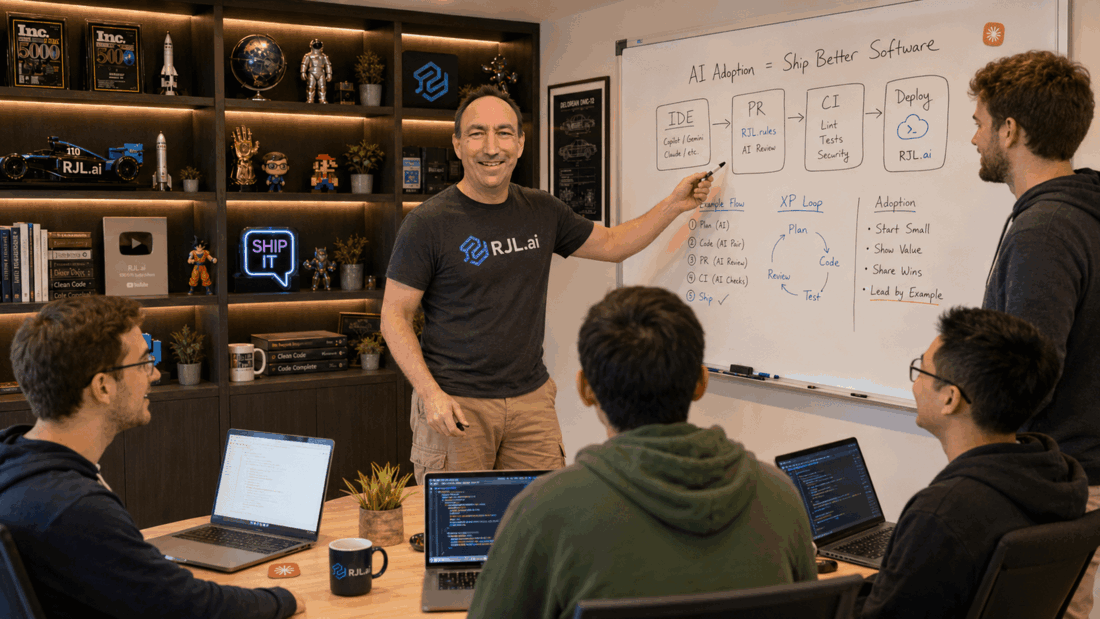
Then I found the places where his caution had quietly become the bottleneck, and challenged him forward with one question: if the downside is this small, what exactly are we protecting by waiting?
He jumped in feet first. Within weeks he was proficient. He later described his own AI journey as having two phases, before that shift and after it - and he wrote it down publicly, which is why it appears in the recommendations on the home page rather than only in mine.
The impact compounded. The team moved faster on static analysis gates in CI. CI/CD automation improved. Quality conversations got sharper. The stability and velocity we had been trying to unlock for years finally started showing up in the system. Not because AI replaced engineering judgment, but because it helped one of our strongest engineering minds remove friction from work he already knew needed to happen.
The blocker to adoption is rarely the model. It is the gap between an engineer's perceived risk and the actual risk.
Senior engineers protect quality by default. That instinct is a feature, not a bug. The job is not to override it, it is to recalibrate it with evidence and then champion the ideas they were already trying to push through. You do not accelerate adoption by being louder. You do it by being the first one in the water.