Execution Principles
Strategy without execution is hallucination.
- Stop duct-taping AI onto old workflows. Real value comes from reimagining the process from the ground up.
- AI must prove its value, not just promise it. I build systems that earn the trust of skeptical development teams by delivering tangible results.
- Embed with purpose, don't retrofit with hope. AI is a foundational element of the architecture, not a feature bolted on later.
- The goal is acceleration, not just automation. We empower teams with Frontier LLMs like Claude and OpenAI, creating clarity and a state of flow, freeing them to solve bigger problems.
- AI Theater is not AI Transformation. 70% of routine PR reviews AI-assisted. 55% developer toil eliminated. 4x faster onboarding. These are measured results. If it cannot be measured, it is not in the plan.
- Transformation is organizational, not just technical. AI Transformation that only touches Engineering fails. I drive adoption across Operations, HR, and Product with change management, governance, and executive alignment.
The Context Revolution
We've been optimizing the wrong thing.
For years, we architected systems around how we think - classes, layers, patterns, frameworks. Then Frontier LLMs matured, and the rules changed permanently. The fastest-moving teams aren't winning by writing better prompts. They're winning by recognizing a fundamental shift: AI operates on context, not abstraction. While competitors were prompt-hacking, winners were architecting context as a first-class concern. They standardized it (AGENTS.md, CLAUDE.md, CONTEXT.md). They versioned it. They made it infrastructure. The competitive advantage isn't your code anymore. It's how well you feed context into the Frontier LLMs that generate your code.
Markdown is the Substrate
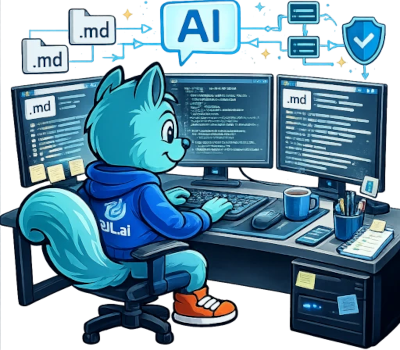
Markdown has become the de facto standard for AI-native organizations. It's token-efficient, easily parsed, and both human- and machine-readable. Strategic plans, architecture decisions, and product roadmaps all belong in version-controlled .md files. This is the substrate for building with AI.
Context as a Product
Requirements are now code, written in a language understood by both humans and AI agents. This is the essence of agentic development: designing with AI, not just prompting it. I call this the SP(IDE)R approach, turning ideas into structured, versioned artifacts that evolve with your codebase, not in a stale wiki.
AI Codes, Engineers Architect
Generative AI excels at coding tasks, but software engineering is about building resilient, scalable systems. AI can write a function, but an engineer must architect the system. My approach leverages AI for the former, freeing up engineers to focus on the latter.
Leverage, Not Replacement
Senior engineers architect context. AI multiplies their expertise, automating repetitive tasks and scaling strategic work. This isn't about replacing engineers; it's about leveraging their experience to solve bigger problems.
MCP: The Protocol Layer for Agentic Infrastructure
The Model Context Protocol (MCP) and Agent-to-Agent (A2A) protocols are the connective tissue of production agentic systems. MCP lets AI agents reach into codebases, CI/CD pipelines, observability tools, and internal APIs -- giving them real operational context, not just document summaries. When context is infrastructure and MCP is the protocol, AI agents stop being assistants and start being contributors with measurable SLOs.
The Intent Imperative
Context without intent is like a loaded weapon with no target.
Enterprise AI is undergoing its next major shift. For years, the competitive edge lived in prompt engineering, then context engineering -- feeding the right information to the right model at the right time. That era is ending. The organizations pulling ahead now are investing in intent engineering: explicitly embedding goals, values, and trade-offs directly into autonomous agents before they act.
The boldest truth in enterprise AI today is this: an organization with a mediocre model and strong intent infrastructure will consistently outperform a company running a frontier model without alignment. Model capability is table stakes. Intent is the differentiator.
The Alignment Warning
Deploying autonomous agents without strict, goal-oriented alignment isn't just a technical risk -- it's a business liability. Agents operating on context alone know what to do but have no principled basis for deciding whether they should. Context tells the agent what's true. Intent tells it what to value. Without intent, you've built a powerful system pointed at nothing in particular.
Speed Without Wisdom
AI can automate tasks with a flawlessness and speed that humans cannot match. That's the promise. The warning is equally real: the moment you remove the human context needed to intuitively navigate customer feelings, relationships, and organizational trust -- speed becomes destruction. Automation that loses the human thread doesn't just fail to delight customers. It actively erodes the trust that took years to build.
Intent as Infrastructure
The teams I build treat intent the same way we treat context: as versioned, governed infrastructure. Every autonomous agent ships with explicitly documented goals, defined trade-offs, and clear value hierarchies. This isn't a philosophy exercise. It's the engineering discipline that determines whether your AI Transformation creates leverage or liability.
How I Work
I integrate AI across the complete journey from idea to shipping - whether it's a new product or new feature.
- AI-Powered Ideation & Validation. From initial concept to market fit analysis, AI analyzes trends, competitive landscapes, and user signals to validate ideas before you invest engineering time.
- Augment Existing Tools. Enhance VS Code, JetBrains, Claude Code, and other Frontier LLM tools your team already uses - no forced stack changes.
- Pipeline-Native AI. Build AI agents directly into your delivery pipeline for seamless, invisible integration.
- Global Team Leadership. Lead 175+ high-performing remote and hybrid engineers across continents with proven methodologies.
- Full-Spectrum AI Integration. Apply AI across the entire journey: ideation → market research → requirements → architecture → development → testing → deployment → launch → optimization.
- Measurable Business Impact. Focus on tangible results: faster validation, reduced time-to-market, accelerated sprints, fewer failed launches, and improved team morale.
- Organizational Change Management. Build executive alignment, address cultural resistance, and create adoption playbooks that bring Operations, HR, and Product along -- not just Engineering.
- AI Governance & Risk. Establish policies for data privacy, IP ownership, model risk, and vendor strategy before scaling. Responsible AI adoption that earns board-level trust.
Where I Focus
I turn AI from a buzzword into business leverage.
- Developer Experience (DevEx). Great tools create great software. I prioritize frictionless environments that teams want to use. If they hate the tools, adoption fails.
- Team Velocity & Flow. Optimize for sustainable speed and deep focus, not just raw output metrics.
- AI Governance & Risk. Data privacy, IP ownership, model risk, compliance, and vendor strategy. Responsible AI that earns board-level trust before you scale.
- Business Impact & ROI. Every AI initiative connects directly to revenue, margins, headcount efficiency, and time-to-market. I build the business case, not just the tech stack.
- Enterprise AI Adoption. Multi-pillar AI strategy across Engineering, Operations, HR, and Product that scales beyond individual teams into organizational culture.
- Organizational Change Management. Executive alignment, adoption playbooks, training programs, and cultural transformation. Technology is 20% of AI Transformation -- people and process are the other 80%.
- Greenfield Innovation. AI-native product lines with executive sponsorship and P&L accountability from day one.
From Idea to Shipping: The Complete AI Journey
Whether it's a new product idea or a new feature, AI accelerates every step from concept to customer.
1. Ideation & Validation
Start with market intelligence, not assumptions. AI analyzes market trends, competitor features, customer signals, and technical feasibility to validate ideas before engineering investment. Transform "we should build X" into data-driven "we should build X because Y."
2. Requirements & Architecture
Capture context in .md files that both humans and AI understand. Competitive analysis, user research, and architectural decisions become versioned, living documents. Requirements evolve with the codebase, not in disconnected wikis.
3. Rapid Prototyping & MLP
AI agents transform structured requirements into working prototypes. From specs to deployable MLPs, context drives wireframes, user stories, API designs, and initial commits. Validate faster, fail cheaper.
4. Development & Testing
Frontier LLMs like Claude and OpenAI pair with engineers through the entire development cycle. Code generation, refactoring, test creation, and security scanning all leverage the same context repository. Your team ships faster while maintaining quality.
5. Deployment & Launch
AI-enhanced CI/CD pipelines explain failures, suggest fixes, and optimize deployments. Agentic AI systems handle rollouts, monitoring, and incident response. Launch with confidence, scale with intelligence.
6. Post-Launch Optimization
Continuous feedback loops powered by AI. User behavior, feature usage, error patterns, and support tickets flow back into improvement plans. The cycle repeats: ideas → validation → build → ship → learn → optimize.
This isn't linear. It's iterative. AI makes each cycle faster, smarter, and more reliable than the last.
What I Build
I don't just talk about AI Transformation. I lead teams that deliver it.

AI-Powered Idea Validation & Market Research
Transform raw ideas into validated opportunities. AI analyzes market trends, competitor landscapes, customer signals, and feasibility to prioritize what to build first. Turn "what if" into "why this" before writing a single line of code.

AI-Driven Competitive Intelligence
Automatically track competitors, analyze feature gaps, and identify market whitespace. AI agents monitor industry movements, extract insights from competitor products, and synthesize findings into actionable strategic documents.
Executive AI Readiness & ROI
Assess organizational readiness for AI Transformation. Build the business case with projected revenue impact, headcount efficiency, and time-to-market acceleration that earns executive sponsorship and board approval.
Agentic MLP Acceleration
AI agents pair with your team to go from structured specs to working prototypes. Context drives wireframes, user stories, and scoped commits.
AI-Enhanced User Research & Feedback
Continuously gather and synthesize user feedback, support tickets, and usage patterns. AI identifies pain points, feature requests, and usability issues, converting them into prioritized improvement plans.
Cross-Functional AI Adoption
AI Transformation that reaches beyond Engineering into Operations, HR, and Product. Adoption playbooks, training programs, and success metrics tailored to each department's workflows and pain points.
AI Pair Programming Environments
Real-time collaboration with Frontier LLMs like Claude and OpenAI. Markdown context flows into refactoring, AI-powered code reviews, and design sessions that level up every engineer.
Autonomous QA Agents
Test coverage that maintains itself from requirements, finds gaps, and flags issues before they hit staging. Context-aware, always current.
AI Training & Enablement
Structured programs that move teams from AI-curious to AI-proficient. Role-specific training for engineers, product managers, operations leads, and executives. Measure adoption, not just attendance.

AI Governance & Risk Frameworks
Data privacy policies, IP ownership guidelines, model risk assessment, compliance controls, and vendor evaluation criteria. Responsible AI that satisfies legal, security, and board-level scrutiny.
AI-Enhanced CI/CD
Pipelines that explain failures, suggest fixes, and improve themselves over time using structured context and agentic feedback loops.
Organizational Change Management
Executive alignment workshops, cultural resistance strategies, and phased rollout plans. Build internal champions, measure adoption velocity, and sustain transformation momentum beyond the initial pilot.

AI Launch Strategy & Go-to-Market
From release planning to post-launch optimization, AI analyzes launch readiness, predicts rollout risks, and monitors adoption patterns. Context-aware agents generate launch checklists, rollout strategies, and optimization recommendations.
Internal Developer Platforms (IDPs)
Self-service platforms giving engineers governed access to CI/CD, observability, secrets, and AI agent tooling without filing tickets. 55% toil reduction. 4x faster onboarding. IDPs are the foundation that makes AI-native engineering sustainable at scale.
AI that ships. AI that scales. AI that frees your team to move faster and think deeper.
Proof, Not Promises
I've done this. I can do it for your company.
I inherited a global engineering organization running legacy desktop software, fragmented teams, and no AI strategy. Over three years, I led a transformation that touched every pillar of the business:
- Revenue Impact. Identified and delivered a field technician mobile app outside the original scope that now generates over $400k/month in recurring revenue -- a product line that did not exist before I arrived.
- Platform Modernization. Led the complete rewrite of a legacy .exe to cloud-native microservices on .NET 8 and Java across AWS and Azure. Eliminated 75% of accumulated tech debt while maintaining production stability and zero downtime migration.
- Engineering Culture & DevEx. Built and scaled a team of 175+ engineers across multiple continents. Reduced new-hire ramp-up time by 40%, increased PR velocity by 30%, and established DevEx as a first-class organizational priority with servant leadership and AI-native tooling.
- AI Transformation. Designed and operationalized a multi-pillar AI strategy spanning Engineering, Operations, and Product. Moved beyond pilot projects to organization-wide adoption with governance frameworks, training programs, and executive-level reporting on AI-driven productivity gains.
- Platform Reliability. Implemented SRE practices, intelligent monitoring, and resilient architecture patterns that delivered 99.995% uptime while scaling platforms to 10x traffic growth without proportional headcount increases.
- Infrastructure Cost Reduction. Delivered $2M+ in infrastructure savings through cloud-native modernization, right-sizing, eliminating unused services, and AI-driven resource management that scales cost with actual usage.
- Agentic Toil Elimination. Deployed agentic AI workflows automating repetitive engineering tasks -- PR review, testing, documentation generation, environment management. 55% reduction in developer toil, freeing engineers for work that requires human judgment.
- Internal Developer Platform. Rebuilt the internal developer platform so new engineers become productive in days, not months. Self-service access to CI/CD, observability, secrets management, and AI tooling. 4x faster onboarding measured across the org.
- AI-Assisted Code Review. Built and deployed agentic code review systems that handle 70% of routine PR reviews autonomously -- with full codebase context, architecture awareness, and audit trails. Engineering velocity increased 30% while defect escape rates dropped.
The result: faster time-to-market, new revenue streams, dramatically lower tech debt, and an engineering culture that attracts and retains top talent. This isn't theory. This is a transformation I led from start to scale.
What People Say
From engineers and executives who have worked alongside me.
"RJ transformed our platform modernization initiative. His AI-native approach cut deployment time by 60% while maintaining quality. A true leader who codes and mentors with equal skill."
Alexander Sante
SVP Engineering, Financial Services
"Working with RJ was a masterclass in cloud architecture. His expertise in AWS and Kubernetes helped us scale from 10K to 1M users seamlessly. He is the rare executive who can both strategize and debug production issues."
Michael Chen
CTO, Healthcare Technology
"Best mentor I have ever had. RJ does not just teach technical skills -- he teaches you how to think like a leader. His 1:1s transformed my career trajectory from IC to tech lead."
Jiten Patel
Senior Engineer, SaaS Company
This isn't the future. It's operating at scale.
You don't need a moonshot to get started. You need a hands-on executive who operationalizes AI Transformation across your entire organization -- not just Engineering, but Operations, HR, and Product. Someone who builds governance before scaling, earns buy-in before mandating, and delivers measurable business outcomes that justify continued investment. That's what I do.
Why RJ
A unique combination of technical depth, organizational leadership, and business acumen.
- Proven Business Impact. 34+ years in software and 30+ as an executive, with measurable results: $400k/month new revenue stream, 40% faster ramp-up, 30% PR velocity boost, 75% tech debt elimination, 99.995% uptime, $2M+ infrastructure savings, 55% toil reduction, 4x faster onboarding, and 70% of routine PR reviews AI-assisted.
- Industry Domain Breadth. Delivered results across FinTech (PCI-compliant), MedTech (HIPAA-compliant), EduTech, B2B SaaS, and PE-backed environments. Each domain's compliance and scale requirements handled from day one.
- Organizational Transformation. I don't just transform Engineering -- I drive AI adoption across Operations, HR, and Product with change management, training programs, and executive alignment.
- Full-Spectrum Technical Expertise. From .NET 8, Java, AWS, and Azure to Frontier LLMs, AI-native architectures, DORA metrics, and the SPACE framework. I guide teams through the complete journey from idea validation to shipping and optimization with engineering excellence benchmarks that translate to board-level outcomes.
- Global Team Leadership. Experience scaling and leading 175+ high-performing remote and hybrid engineers across continents with servant leadership and DevEx-first culture.
- AI Governance & Risk. I build governance frameworks covering data privacy, IP ownership, model risk, compliance, and vendor strategy -- responsible AI that earns board-level trust.
Explore the RJL.ai Universe
The RJL Network
Connect with me
Developer Reference
Powered by cutting-edge web technologies